
Lesson 3.2
What Makes Triangles the Same?
Focus: triangle congruence defined — SSS/SAS/ASA/AAS discovered — SSA and AAA disproved — accepted as postulates
This lesson uses physical manipulatives to discover the congruence shortcuts. The goal is for students to arrive at SSS, SAS, ASA, and AAS through genuine inquiry — testing combinations, forming conjectures, seeking counterexamples — before any names are given. The names should land on something students already understand. It is important to include HL when you consolidate the lesson. I did not make a manipulative to arrive at it, but it is pretty easy to draw and will be needed for future proofs.
Manipulative preparation: you do not need five different triangle sets. One triangle, printed and traced onto card stock, works perfectly well. The variety in the full manipulative set was intended to show students that the shortcuts are not specific to one triangle — but this universality can simply be stated rather than demonstrated through different sets. Students accept it readily. Choose one or a few and prepare enough sets for your groups.

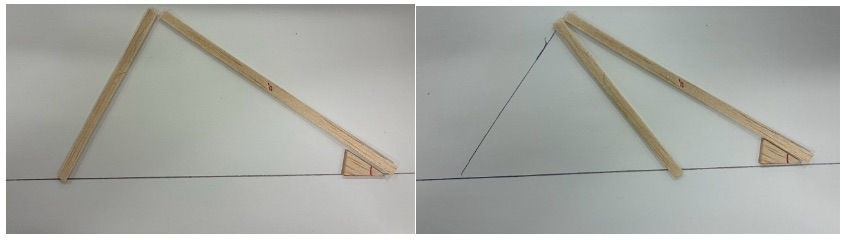
SSA is the most important failure to demonstrate. Most students, without additional support, will only build one triangle from the given pieces and conclude SSA works. They will not see the second position. The reference line technique is essential: draw or tape a straight baseline on paper, place the angle piece at one end, and let the second side-length strip pivot freely from the angle vertex. Students can then see — visually and physically — that there are two positions where the strip meets the baseline. Two different triangles from the same SSA information. Without this physical demonstration, students who happen to build one triangle will incorrectly conclude SSA works, and that incorrect belief will cause errors in proof writing throughout the unit.
AAA counterexample: draw triangle ABC, then draw a line DE parallel to BC, where D is on AB and E is on AC. By corresponding angles, triangle ADE has all three angles equal to triangle ABC. But it is clearly smaller — not congruent. One counterexample disproves a universal claim. Students who found AAA intuitive (‘same shape, different size’) now have a geometric argument rather than just an intuition.
An epistemological choice worth naming honestly:
The four valid shortcuts — SSS, SAS, ASA, AAS — can be proven. In Euclid’s Elements, SAS is Proposition 4, SSS is Proposition 8, and both ASA and AAS are covered in Proposition 26. These are earned results, not starting assumptions.
Euclid’s proofs of these propositions involve a method called superposition — placing one triangle on top of another and arguing that they must coincide. Hilbert later identified this as one of the places where Euclid was implicitly using assumptions he had not formally stated in his axioms. The method of superposition requires assumptions about the rigidity of geometric figures and the ability to move them — assumptions Euclid did not explicitly list. Hilbert’s more rigorous treatment adds axioms that make superposition legitimate.
By accepting SSS, SAS, ASA, and AAS as postulates, we sidestep this thorny issue entirely. We are not proving them — we are accepting them as given, which avoids both the need for superposition and the implicit assumptions that come with it. This is a defensible choice at the level of this course, and it is worth being honest with students about: these shortcuts can be proven, but the proofs involve a technique Euclid himself was not fully justified in using. We are accepting them as postulates so that we can use them to practice proving other things. That is a choice, not a gap.